


Every week, our sales team receives the same question from small farmers and farm supply dealers across South America: "I want a machine to chop feed for my animals. Which one should I buy?" The question sounds simple. The answer is not, because the three machines most people call "feed choppers" do three genuinely different jobs, and buying the wrong one is one of the most common and most expensive mistakes in small-scale farming.
A chaff cutter, a feed grinder and a forage chopper all reduce the size of plant material, so it is understandable that buyers treat them as interchangeable. But one cuts stalks to length, one pulverizes grain into meal, and one shreds wet green material at high speed. Choose the wrong mechanism and you will either damage the machine, waste money on capacity you do not need, or spend every morning fighting a machine that was never designed for your crop.
This guide explains the difference in plain language, shows which machine fits which feed material and which livestock, and gives you a practical decision framework you can use before you spend a single peso or dollar. It is written for the reality of small farms and family workshops in Argentina and Chile, not for industrial feed mills.
|
>> Download the Zenterest Compact Feed Chopper Catalog - All Models, Specs and Prices << |
Three Families of Machines, Three Very Different Jobs
Before comparing models, it helps to understand what each machine family was invented to do. All three appear in the same product categories on most websites, which is exactly why buyers get confused.
Chaff Cutters: Cutting Stalks to a Set Length
A chaff cutter is the oldest and simplest of the three. Its job is to take long material - maize stalks, sorghum, sugarcane tops, rice straw, hay - and cut it into short, uniform lengths. The cutting action is a guillotine: a heavy blade passes a fixed counter-blade and shears the material at a preset length, usually adjustable between roughly one and five centimeters.
Because the output is measured in length rather than fineness, chaff cutters are the correct choice when your animals need fiber structure in the ration. Dairy cattle, beef cattle, goats and sheep all benefit from chopped forage that is short enough to eat comfortably but long enough to stimulate rumination. A chaff cutter preserves the physical structure of the forage, which is exactly what a ruminant digestive system needs.
Feed Grinders: Reducing Material to Meal
A feed grinder, often called a hammer mill, works on a completely different principle. Instead of shearing, it uses rapidly rotating hammers to smash material against a screen until it passes through the holes. The output is not chopped stalks; it is meal or flour - grain, dried maize, soybean, dried cassava chips and similar hard material reduced to a powder or coarse grit.
Grinders are essential when you formulate concentrated feed. If you mix your own rations from maize, sorghum, soybean meal or dried root chips, you need a grinder to reduce those ingredients to a consistent particle size so the animals cannot sort them apart. But a grinder is the wrong tool for fresh green forage: wet material blinds the screen, the hammers smear rather than cut, and output drops to almost nothing.
Forage Choppers: High-Speed Cutting for Green and Wet Material
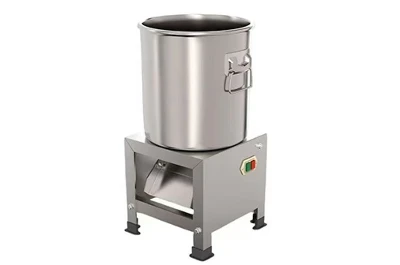
A forage chopper sits between the two. It uses high-speed rotating blades to cut fresh green material - grass, maize silage, alfalfa, vegetable leaves, water hyacinth - into short pieces quickly. The difference from a chaff cutter is speed and throughput; the difference from a grinder is that it cuts rather than smashes, keeping plant cells intact and preserving moisture and vitamins.
Forage choppers, and the more specialized vegetable and poultry cutters we build, are the right choice when your material is wet, soft, stringy or leafy. They shear cleanly, resist wrapping around the shaft, and produce a uniform product that animals cannot sort.
Cutting Versus Grinding: Why the Mechanism Matters
The mechanism is not a technical detail - it determines what your animals actually digest. When a blade shears plant material cleanly, the cell walls stay largely intact and the sugars and moisture stay inside. When a hammer smashes the same material, cells rupture and juice is lost, which is why ground wet forage turns into a sour, unpalatable paste within hours.
The reverse is also true for hard material. A blade cannot reduce a dry maize kernel to meal no matter how sharp it is; you need impact. This is why experienced small farmers in Argentina and Chile often end up with two machines on the farm - a chopper for forage and a small grinder for grain - or with one carefully chosen multifunctional machine that does both at a reasonable level.
If you can only buy one machine this season, the correct question is not "which is best" but "which feed occupies the largest share of my daily ration". Answer that honestly and the category chooses itself.
|
>> Tell Us What You Feed - Get a Free Machine Recommendation from Our Specialist << |
Match the Machine to Your Feed Material
The table below is the fastest way to narrow your choice. Find your main feed material in the left column, and the recommended machine family appears on the right.
|
Main feed material |
Recommended machine |
Why it works |
|
Maize stalks, sorghum, sugarcane tops, straw, hay |
Chaff cutter or forage chopper |
Cuts to adjustable length, preserves fiber structure for rumination |
|
Fresh grass, alfalfa, green forage |
Forage chopper |
High-speed clean cut, handles high moisture without clogging |
|
Vegetable leaves, market waste, vines |
Vegetable feed cutter |
Scissor action prevents wrapping, retains cell moisture |
|
Potatoes, cassava, sweet potatoes, fodder beet |
Root crop cutter |
Centrifugal slicing handles dense, soil-covered tubers |
|
Maize grain, soybean, dried chips |
Feed grinder / hammer mill |
Impact reduction to meal for concentrate mixing |
|
Mixed material, changing daily |
Multifunctional processor |
One machine, adjustable settings, lower total investment |
Match the Machine to Your Livestock
Feed material is the first filter; livestock is the second. The same crop can require a different cut length depending on which animal eats it.
Cattle and Dairy Cows
Cattle need fiber. A dairy cow's rumen depends on physically effective fiber to maintain fermentation and milk fat. Chopping to roughly two to four centimeters is the sweet spot: short enough to prevent sorting and to allow comfortable eating, long enough that the animal still chews and produces saliva. Over-chopping into a mush reduces rumination and can depress milk fat, which is why a chaff cutter set to a moderate length often outperforms a high-speed shredder on a dairy farm.
Goats and Sheep
Small ruminants are selective eaters and will pick through a ration to find the pieces they prefer, leaving the rest to spoil. Uniform chopping to about two to three centimeters reduces this sorting behavior dramatically and lowers feed refusal. Goats browse more than sheep and accept slightly coarser material, but both species benefit from consistency far more than from fineness.
Poultry
Poultry are the exception. Chickens, ducks and geese have short digestive tracts and no rumen, and long stringy fibers can cause crop impaction, a condition that kills birds quickly. Poultry require an ultra-fine cut, which is why a dedicated poultry feed cutter with a high-density blade rotor exists as a separate product rather than being handled by a standard forage chopper.
Pigs
Pigs are omnivores with a simple stomach and benefit from finely divided feed. Root crops are a classic pig feed in South America, but whole or chunky tubers are a choking hazard. A root crop cutter that slices to a uniform thickness of two to ten millimeters turns cheap cassava or sweet potato into safe, highly digestible feed and reduces waste considerably.
Where the Categories Overlap: Multifunctional Machines
The three categories were described separately for clarity, but in the real world small farms rarely have only one feed type. A typical mixed farm in the Argentine interior might feed maize stalks in summer, alfalfa hay in winter, and vegetable surplus from a nearby market whenever it is cheap. Buying three machines is impossible; buying one machine that does one job well and two jobs badly is also a mistake.
This is why multifunctional processors have become the best-selling category for small farms. A well-designed multifunctional unit combines a chopping chamber with interchangeable or adjustable components, letting you change from green forage to dry straw to grain with a short setup change. It will never match a dedicated machine at its single specialty, but it delivers eighty percent of the capability at a fraction of the total investment, which is exactly the right trade-off for a farm processing a few hundred kilograms a day.
Our practical advice: if more than seventy percent of your feed is one material, buy the dedicated machine. If your feed mix is genuinely varied, buy a multifunctional unit and accept the compromise. If you are a dealer, stock one of each - the dedicated models sell to specialists and the multifunctional models sell to everyone else.
|
>> Compare All Compact Models Side by Side - Request the Full Comparison Sheet << |
Five Mistakes Small Farmers Make When Buying Their First Machine
After years of supplying small farms across South America, we see the same five mistakes repeatedly. Avoiding them will save you more money than any discount you negotiate.
Buying on price alone. The cheapest machine usually has thin carbon blades, an undersized motor and no spare parts supply. It fails within one or two seasons, and the replacement cost exceeds what a quality machine would have cost.
Buying industrial capacity for a small farm. A three-phase machine that requires an electrical upgrade, a concrete pad and a trained operator is not a bargain; it is a permanent cost. Match capacity to your daily tonnage, not to the biggest number on the specification sheet.
Ignoring the feed material. A grinder cannot chop wet grass and a forage chopper cannot make grain meal. Confirm the mechanism matches your main material before you compare brands.
Forgetting spare parts. Blades, belts and bearings wear out. Before you buy, ask how fast the supplier can ship replacements and at what price. A machine with no parts support is scrap waiting to happen.
Skipping the power check. Argentina and Chile both run 220V at 50Hz on most rural properties. Confirm the motor is configured for single-phase 220V and that your supply can carry the load, otherwise you will be paying for an electrician the week the machine arrives.
Cost, Throughput and Payback Comparison
The figures below are indicative ranges for compact machines suitable for small farms and family workshops. Actual prices vary by model, configuration and order volume, but the relative relationship between categories holds true.
|
Machine type |
Typical throughput |
Typical price band |
Best suited to |
|
Compact chaff cutter |
150 - 400 kg/h |
Low |
Cattle, goats, sheep; dry and green stalks |
|
Forage chopper |
200 - 500 kg/h |
Low to mid |
Dairy, silage making, fresh green forage |
|
Feed grinder |
100 - 300 kg/h |
Low |
Grain and concentrate mixing |
|
Root crop cutter |
150 - 400 kg/h |
Low to mid |
Pig farms, cassava and potato regions |
|
Multifunctional processor |
150 - 350 kg/h |
Mid |
Mixed farms with varied daily feed |
Payback is fast in every category because the alternative is manual labor. A farm chopping three hundred kilograms a day by hand spends four to five hours on the task. The same work takes about one hour with a compact machine. At any realistic rural labor cost, the machine repays its purchase price within weeks to a few months, and every day after that is pure saving.
Why Small Farms and Dealers in Argentina and Chile Buy Through Zenterest
Zenterest is a Chinese manufacturer and export supplier of compact feed choppers, forage cutters, chaff cutters and feed processing equipment, with nearly a decade of export experience and customers in more than twelve countries. Our company was established in 2017 in Jiaxing, Zhejiang Province, and today employs a professional team of over one hundred staff with an annual turnover exceeding one hundred million RMB.
What makes us different from a single factory is our supply model. We work with more than a dozen specialized partner factories across China. By consolidating large-volume orders across that network, we obtain preferential pricing tiers, priority production slots and bulk discounts that individual buyers cannot access even when they contact a factory directly. That aggregated purchasing power is the reason our wholesale prices are difficult to match, and it is why distributors in price-sensitive markets choose to source through us rather than direct.
For buyers in Argentina and Chile specifically, we configure machines for the local 220V/50Hz single-phase supply, provide Spanish-language manuals and documentation, and ship regularly to Buenos Aires, San Antonio and Valparaiso. Our one-stop service covers product selection, OEM and private-label customization, pre-shipment inspection, consolidated container loading, marketing material support and after-sales spare parts dispatch.
Dedicated compact models plus multifunctional units, so you can match the machine to the feed rather than compromise
Factory-network pricing that individual factory buyers cannot obtain
220V/50Hz configuration and Spanish documentation for South America
Low minimum order quantities and mixed-model containers for dealers testing the market
OEM branding, custom colors and retail-ready packaging for distributors
Spare parts stock and fast dispatch to protect your customers' uptime
Frequently Asked Questions
Can one machine chop forage and grind grain? A multifunctional processor can do both at a workable level, but a dedicated grinder will always produce finer, more consistent meal. If grain is a small part of your ration, the multifunctional compromise is sensible. If you mix substantial concentrate, buy a small grinder as well.
Is a chaff cutter the same as a forage chopper? Not exactly. Both cut material to length, but a chaff cutter is a low-speed guillotine designed for stalks and straw, while a forage chopper uses high-speed blades for wet green material. Many small farms can use either for green maize, but only a chaff cutter handles dry straw comfortably.
What cut length should I set? For cattle, roughly two to four centimeters. For goats and sheep, two to three centimeters. For poultry, ultra-fine. For pigs, thin slices rather than long pieces. Start in the middle of the range and adjust based on how much the animals leave uneaten.
Will a compact machine handle several hundred kilograms a day? Yes. Compact machines are rated for continuous small-scale work at roughly two hundred to five hundred kilograms per hour, which covers the daily needs of most small farms and family workshops comfortably.
Do you supply spare blades and belts? Yes. We maintain stock of wear parts including blades, belts and bearings, and dispatch them quickly to minimize downtime. Dealers can hold a small parts inventory for their local customers.
The Simple Decision Rule
If you remember nothing else from this article, remember this: choose the machine by your main feed material first, by your livestock second, and by price third. A slightly more expensive machine that matches your feed will outperform a cheap machine that does not, every single day, for years.
If you are still unsure, send us a short description of what you feed, how many animals you keep and what power supply you have. Our specialists will recommend two or three models with pricing, and you can compare them against the framework in this guide. There is no charge for the consultation, and no obligation to buy.
|
>> Get a Free Machine Recommendation - Send Us Your Feed Details Today << |


