


Small ruminant farming is one of the fastest-growing segments of livestock production in South America. Dairy goats supply cheese markets in Argentina and central Chile, meat goats and sheep support rural incomes across dry regions, and both species thrive on land that is too small, too steep or too dry for cattle. Yet many of these farms still prepare feed the way their grandparents did - by hand, with a machete, or by throwing whole forage into the pen.
That single habit quietly caps productivity. Chop length is one of the few variables a small ruminant farmer can control completely, costs almost nothing to change, and influences feed intake, digestibility, milk yield and feed waste all at once. Getting it right is arguably the highest-return management decision available to a goat or sheep operation, and it requires nothing more than the correct machine setting.
This article explains why particle size matters so much for goats and sheep, what length to target for each species and production stage, how to build a simple feeding routine around it, and which compact machines suit small ruminant farms in Argentina and Chile.
|
>> Talk to a Zenterest Specialist About the Right Chopper for Goats and Sheep << |
Why Particle Size Is the Most Overlooked Profit Lever
On a dairy goat farm, feed is typically sixty to seventy percent of total production cost. That means a five percent improvement in feed efficiency is worth more than a five percent increase in milk price, and it is usually far easier to achieve. Particle size is the cheapest lever available because it requires no new feed, no new animals and no new buildings - only a consistent cut.
The mechanism is straightforward. Goats and sheep are ruminants: they depend on a microbial population in the rumen to break down fiber. Those microbes work best when the material they receive is uniform and when the animal chews enough to produce saliva, which buffers the rumen. Chop too coarse and the animal sorts, wastes and under-digests. Chop too fine and rumination drops, the rumen becomes acidic, and milk fat falls. The target is a narrow band in the middle, and hitting it consistently is where mechanization pays.
The Rumen Science in Plain Language
You do not need a nutrition degree to apply this, but three facts explain almost everything you will observe in the pen.
- Fact one: rumination depends on fiber length. Every time a goat or sheep chews its cud, it produces saliva that neutralizes acid in the rumen. Long, structured fiber stimulates chewing. When forage is chopped into a fine mush, chewing drops, saliva drops, and the rumen becomes more acidic - a condition that reduces fiber digestion and, in dairy animals, depresses milk fat.
- Fact two: uniformity beats fineness. Animals eat what is easiest to pick out. If a ration contains long stems mixed with fine leaves, goats will select the leaves and leave the stems, and the stems spoil. A uniform chop removes the ability to sort, so every animal consumes the ration you actually formulated.
- Fact three: clean cuts preserve nutrients. A sharp blade shears plant cells; a blunt blade or a smashing action ruptures them and releases juice. Released juice oxidizes, heats and sours, especially in warm climates. A clean, uniform cut keeps more sugar and moisture inside the plant tissue and keeps the feed palatable for longer.
The Hidden Cost of Long Forage: Sorting and Refusal
Feed refusal is money on the floor. On a typical small goat farm, feeding long forage results in refusal rates that many farmers estimate at five percent and that measurement usually puts closer to fifteen or twenty percent. The animal eats the palatable fraction, tramples the rest, and the farmer compensates by feeding more.
There is a second, less visible cost: sorting changes the ration. If you formulated a mix with a specific protein and energy balance, and the animals eat only the leafy fraction, the effective ration they consume is not the ration you calculated. Milk yield becomes unpredictable, body condition fluctuates, and the farmer concludes that the feed is poor when the real problem is presentation.
Uniform chopping to a consistent length solves both problems at once. Refusal drops sharply, and because animals can no longer sort, the ration they eat matches the ration you designed. Most farms that make this change report that they can reduce total feed offered by ten to fifteen percent with no drop in production - which is effectively a direct margin improvement.
|
>> Calculate Your Feed Savings - Request a Free Farm Assessment << |
What Chop Length for Dairy Goats Versus Sheep?
The correct length differs slightly between species and changes with production stage. Use the table below as a starting point, then adjust based on what your animals actually leave in the trough.
|
Animal and stage |
Target chop length |
Reason |
|
Dairy goat, lactating |
2 - 3 cm |
Maximizes intake while maintaining rumination and milk fat |
|
Dairy goat, dry period |
3 - 5 cm |
More structured fiber, lower cost, maintains rumen health |
|
Meat goat, growing |
2 - 4 cm |
Balances intake and digestibility for growth |
|
Sheep, wool and meat |
2 - 4 cm |
Sheep graze closer and prefer shorter, uniform material |
|
Sheep, pregnant ewe |
3 - 4 cm |
Prevents sorting, supports intake in late gestation |
|
Young stock, both species |
1.5 - 2.5 cm |
Smaller mouths, need shorter pieces to eat comfortably |
|
Poultry (for reference) |
Ultra-fine |
Different digestive anatomy, no rumen, choking risk |
Two practical warnings. First, do not chop finer than necessary. There is a common belief that finer equals better digestion, but for ruminants the opposite is true once you pass below roughly one and a half centimeters: rumination falls and rumen health deteriorates. Second, do not change length abruptly. Transition over seven to ten days so the rumen microbial population can adapt.
Beyond Length: Uniformity, Cleanliness and Freshness
Length is the headline, but three related factors determine whether your chopping actually improves production.
Uniformity. A machine that produces a mix of dust and long stems is worse than a hand-cut ration, because it creates sorting. Check uniformity by grabbing a handful of output and looking for variation. A well-set machine produces pieces within a narrow range.
Cleanliness. Soil on root crops and dust on dry straw dull blades and introduce grit into the feed. A dull blade crushes rather than cuts, which defeats the entire purpose. Sharpen or replace blades on schedule, and pre-clean soil-covered material where practical.
Freshness. Chop close to feeding time, especially in hot climates. Chopped green material begins to heat and ferment within hours. Small farms should chop in batches sized to one or two feedings rather than chopping a week's supply at once.
Building a Simple Feeding Routine for a Small Dairy
Mechanization works best when it is embedded in a routine. The following sequence is used successfully by small goat and sheep dairies in Argentina and Chile and requires no special equipment beyond a chopper and a feed trough.
- Step 1 - Weigh or estimate your daily forage requirement per pen. A rough working figure is three to four percent of body weight in dry matter for lactating animals.
- Step 2 - Chop in batches matched to feeding times, typically morning and late afternoon, so feed is fresh at both feedings.
- Step 3 - Set the cut length for the group you are feeding. If you run mixed groups, chop two batches rather than compromising on one setting.
- Step 4 - Mix the chopped forage with concentrate evenly, so animals cannot separate the components.
- Step 5 - Feed at the same times each day. Ruminants perform best on routine, and consistent timing makes intake easier to measure.
- Step 6 - Record refusal the following morning. Persistent refusal above five percent signals that the chop is too long, the ration is unbalanced, or the animals are being overfed.
- Step 7 - Review monthly against milk yield, body condition and feed cost per liter. Adjust length and ration before adjusting anything more expensive.
Which Compact Machines Fit Goat and Sheep Operations
Small ruminant farms rarely need large equipment, but they do need the right mechanism. The most common choices among our customers in this segment are:
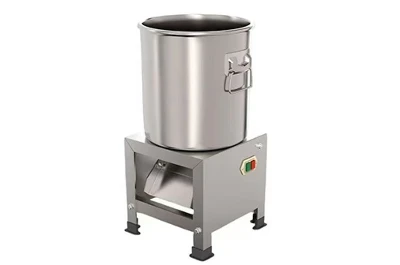
- Chaff cutter or compact forage chopper: The workhorse for goats and sheep. Handles green forage, hay and stalks, cuts to an adjustable length in the two to five centimeter range, runs on standard 220V single-phase power and fits in a small shed. This is the first machine most small ruminant farms should buy.
- Multifunctional processor: A sensible choice for farms that also grow grain or process root crops, because it combines chopping with other functions in one compact unit and reduces total investment.
- Root crop cutter: Relevant where cassava, potato or fodder beet forms part of the ration. Uniform slices prevent choking and improve digestibility compared with whole or roughly broken tubers.
- Vegetable feed cutter: Useful for farms near vegetable markets that rely on leafy waste. The scissor action prevents the wrapping and clogging that conventional choppers suffer with wet, stringy material.
In every case, confirm two things before ordering: that the machine is configured for 220V/50Hz single-phase supply, and that the cut length adjusts into the range you need. A machine whose minimum length is five centimeters is useless for dairy goats, no matter how well built it is.
|
>> Request Cutting-Length Specifications for All Compact Models << |
What Results Should You Expect?
Be realistic. Chopping does not create nutrition out of nothing, and it will not compensate for poor-quality forage or an unbalanced ration. What it does is remove the losses that stand between your animals and the nutrition already present in your feed.
Farms that move from long forage to a consistent two-to-three centimeter chop typically report three changes within the first two months: refusal drops noticeably, animals eat more steadily through the day, and milk yield becomes more stable rather than swinging with the ration. Over a full lactation, the combined effect of lower waste, higher intake and better rumen health usually translates into a meaningful improvement in feed cost per liter of milk.
The most reliable way to confirm the gain on your own farm is to measure before and after. Record daily feed offered, daily refusal, and daily milk volume for two weeks before you change your chopping routine, then repeat for two weeks after. The comparison will tell you more than any general benchmark.
The Zenterest Advantage for Small Ruminant Farms
Zenterest is a Chinese manufacturer and export supplier of compact feed choppers, forage cutters and feed processing machinery, established in 2017 in Jiaxing, Zhejiang Province, with a professional team of over one hundred staff and annual turnover exceeding one hundred million RMB. We export to more than twelve countries and have particular experience serving small farms and family workshops in South America.
Our supply model is built on more than a dozen specialized partner factories. By consolidating volume across that network, we obtain preferential pricing, priority production and bulk discounts that individual buyers cannot access even when dealing directly with a factory. For distributors and farm supply businesses in Argentina and Chile, this means landed costs that support competitive retail pricing in a price-sensitive market.
We also understand that small ruminant farms need machines that are simple and repairable. Our compact units run on 220V single-phase power, use manganese alloy steel blades that hold an edge, and are designed so that routine maintenance - sharpening, belt tension, bearing checks - can be done on the farm with basic tools. We stock wear parts and dispatch them quickly, because a dairy goat farm cannot afford a machine that sits idle waiting for a blade.
- Compact, single-phase machines sized for small farms and family workshops
- Adjustable cut length suitable for dairy goats, sheep and young stock
- Factory-network pricing unavailable to individual factory buyers
- Spanish documentation and 220V/50Hz configuration for South America
- OEM and private-label options for dealers building a local brand
- Spare parts stock and fast dispatch to protect feeding schedules
Frequently Asked Questions
Is a finer chop always better for goats? No. Below roughly one and a half centimeters, rumination and rumen health decline. For lactating goats, two to three centimeters is usually the best compromise between intake and rumen function.
Can I use the same machine for goats and poultry? Mechanically yes, but poultry need a much finer cut and are at risk from long fibers. If you keep both, either buy a machine with a very wide adjustment range or use a dedicated poultry cutter for the birds.
How often should I sharpen the blades? It depends on volume and material. As a rule, inspect blades monthly and sharpen or replace when the cut looks ragged rather than clean. Processing soil-covered root crops or dry straw accelerates wear.
Will chopping increase my feed costs? It usually reduces them. Better uniformity lowers refusal, and lower refusal means less feed purchased for the same production. The machine itself is a one-time cost that pays back within weeks to a few months.
Do you supply to small farms directly, or only to dealers? We supply both. Dealers benefit from wholesale pricing and OEM options, while larger small farms and cooperatives can order directly. Contact us with your volume and we will confirm the most economical route.
Start With the Chop, Then Optimize Everything Else
Nutritionists often say that the cheapest improvements are the ones you make with equipment you already own. For goat and sheep farms, chop length is exactly that kind of improvement: it requires no new feed and no new animals, only a consistent setting and a clean blade. Get it right and every other investment - genetics, health, housing - delivers a better return because the animals are finally able to extract the nutrition you are already paying for.
If you would like a recommendation specific to your herd size, feed types and power supply, send us the details. We will suggest two or three compact models with pricing and cutting-length specifications, and you can compare them against your own numbers before deciding.
|
>> Get Your Personalized Goat & Sheep Equipment Recommendation Today << |


