


A Sourcing Guide for South American Buyers - Cut Size, Hygiene, Throughput and Power Supply
For agricultural machinery distributors, small food workshops and feed processors | 2026 Edition
Vegetable and Fruit Cutting Machines for Small Workshops (2026): A Sourcing Guide for South American Buyers
There are two kinds of buyer for a vegetable cutting machine, and they are usually sold the same product. The first is an industrial food plant that needs a stainless-steel unit on a continuous line. The second - far more numerous, and far less well served - is the small workshop or family farm that processes a few hundred kilograms a day, works from a single-phase supply, and needs a machine that one person can operate and clean without a maintenance department.
This guide is written for the second buyer, and for the distributors who supply them in Argentina, Chile and the wider South American market. It covers what a vegetable cutting machine actually does, how the machine families differ, the specification points that decide product quality, the hygiene requirements that apply to food contact surfaces, and how to size a unit for a small workshop without buying more machine than the site can use.
What a Vegetable Cutting Machine Actually Does
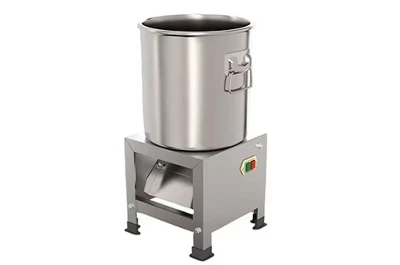
A vegetable cutting machine - also described as a vegetable cutter, vegetable chopper or, for the shredding family, a vegetable shredder - is a powered unit that reduces whole produce to a consistent particle size: slices, strips, cubes, shreds or a coarse chop, depending on the cutting arrangement fitted.
In the small-workshop context the purpose is almost always one of four things:
- Preparing animal feed from vegetable waste, root crops and green matter, as part of a mixed feeding routine alongside chopped forage.
- Pre-processing for preservation - shredding or slicing produce before drying, dehydration or freezing.
- Preparing ingredients for further processing, such as pulp preparation ahead of juice extraction or cooking.
- Adding value at the point of sale, where a workshop sells prepared produce to households, restaurants or small retailers.
The reason this definition matters commercially is that a supplier quoting "a vegetable cutting machine" may be quoting any of four quite different machines. Establishing which family the buyer actually needs is the first step, and it is the step most often skipped.
Four Machine Families and When to Use Each
The four families below are not interchangeable. A buyer who orders the wrong one will find the machine technically operational but commercially useless for their material.
|
Family |
What it produces |
Best material |
Typical small-workshop fit |
|
Vegetable cutter / chopper |
Coarse chop, short segments |
Green matter, leafy vegetables, stalks |
Feed preparation, mixed workshops |
|
Vegetable shredder |
Shreds and strips |
Root crops, firm vegetables, cabbage-type produce |
Preservation pre-processing, feed workshops |
|
Slicer |
Uniform slices |
Firm produce, tubers, fruit |
Prepared-produce sales, dehydration |
|
Combined cutter and grinder |
Chop plus grind, adjustable |
Mixed material, root crops, grain |
Multi-material workshops where the input changes seasonally |
Two rules help buyers choose correctly. First, match the cutting arrangement to the output the customer sells, not to the input they happen to have today - a workshop that will eventually sell sliced produce should not buy on the basis of this month's shredding requirement. Second, where the input material changes through the year, a combined cutting and grinding unit is generally more durable as a business asset than a single-function machine, because it can be re-tasked rather than replaced.
Cut Size Uniformity: The Specification That Decides Product Quality
If one specification deserves the most attention in this category, it is not motor power. It is cut size uniformity. A machine that produces a wide spread of particle sizes fails in three ways at once: animals sort the ration and the fine fraction is wasted, drying is uneven because a mixed bed dries at the rate of its thickest piece, and prepared produce looks inconsistent to the end customer.
Three factors control uniformity:
- Blade geometry and blade count. Sharp, correctly set blades cutting against a defined aperture produce a repeatable size. Manganese-steel blades are the common specification in this class; blade material and hardness decide how long the machine holds its cut quality.
- Drive stability. A machine that slows under load produces a coarser, more variable cut. Stable shaft speed under varying feed rate is a quality feature, not just a throughput feature.
- Feed control. Uniform presentation of material to the cutting chamber produces a more uniform cut than irregular manual feeding. Where the buyer's process depends on consistency, a hopper or controlled feed arrangement is worth specifying.
The practical way to buy on uniformity is to ask for a cut-size statement on the buyer's own material, and to test a sample. A specification that lists an adjustable cut range without stating achievable uniformity on a named material is only half a specification.
Stainless Steel and Hygiene for Food-Contact Surfaces
For any unit whose output touches food - whether for human consumption or as prepared animal feed - the materials in contact with the product matter, and they are a legitimate purchase criterion rather than a premium add-on.
- Food-grade stainless steel on the cutting chamber, blades and product-contact chute. This is both a corrosion-resistance requirement and a cleaning requirement.
- Accessible internal surfaces. A chamber that can be opened and cleaned quickly is a chamber that gets cleaned. Smooth internal finishing and the absence of crevices reduce material retention and the associated hygiene risk.
- Corrosion resistance in wet service. Wet vegetable processing is aggressive on ordinary steel. In humid or coastal installations the specification matters more, not less.
- Non-contact components - frame, guards, wheels - may reasonably be coated steel. Specify stainless only where it does work; over-specifying drives cost without improving the product.
Buyers should also expect the supplier to describe the cleaning procedure and the material of each product-contact part in the technical file. A supplier who cannot state what the chamber is made of, in writing, is not a supplier to put on a food-contact machine.
Wet and Dry Processing Need Different Machines
One of the most reliable predictors of an under-performing installation is a buyer who assumed a single machine would handle both dry and wet material equally well. In practice, wet and dry processing pull the specification in different directions, and the difference usually shows up as a feed-throat problem rather than a motor problem.
|
Aspect |
Dry / low-moisture material |
Wet / high-moisture material |
|
Dominant bottleneck |
Cutting power and blade sharpness |
Feed throat volume and material bridging |
|
Corrosion requirement |
Standard food-contact stainless adequate |
Higher-specification stainless and accessible drainage |
|
Cleaning burden |
Dust and residue |
Continuous wash-down; drainage design matters |
|
Cut uniformity risk |
Blade wear over the season |
Uneven loading and slipping at the feed opening |
Where a workshop genuinely handles both, the correct approach is a machine designed for the harder case - wet material - with a feed arrangement that can be opened up for dry product, rather than a dry-specification machine asked to cope with wet input. Asking the supplier directly "is this unit rated for continuous wet material or for dry material with occasional wet" is a question that separates a considered quotation from a catalogue entry.
Sizing a Unit for a Small Workshop
Sizing for a small workshop follows the same logic as sizing a feed chopper: work from the daily requirement and the available operating window, then apply a derating factor for real material and real feeding. The failure mode to avoid is buying a machine whose rated throughput is nominally equal to the daily need, which leaves no margin and forces the machine to run at its limit.
|
Workshop profile |
Indicative daily volume |
Operating window |
Implied throughput |
Power supply note |
|
Household or micro workshop |
50–200 kg/day |
0.5–1.0 h |
150–400 kg/h |
Single-phase 220V/50Hz; light-duty cycle |
|
Family food workshop |
200–600 kg/day |
1.0–2.0 h |
300–800 kg/h |
Single-phase 220V/50Hz; specify copper winding |
|
Small commercial processor |
600–1500 kg/day |
2.0–3.0 h |
500–1200 kg/h |
Phase per site supply; confirm starting current |
Two South American market realities shape the sizing decision. First, 220V/50Hz single-phase is the dominant supply at family-workshop scale, so the practical ceiling on motor rating is set by what the site can reliably start - not by what the catalogue offers. Second, rural supply fluctuates, so generous motor and cable specification is a reliability decision rather than an upsell.
Applications That Repay the Investment
Understanding where a vegetable cutting machine earns its cost helps both the end buyer and the distributor recommending it. The most common returns come from four applications.
- Feed preparation at family farms. Replacing hand cutting with mechanised processing reduces labour hours per week and, more importantly, improves cut consistency, which reduces the fraction of feed the animals refuse.
- Mixed material handling in workshops. A unit that handles root crops, vegetable waste and green matter lets a workshop process whatever is available and cheap in a given week rather than being locked to one material.
- Waste recovery. Vegetable waste that would otherwise be discarded becomes usable feed or compost input once reduced to a consistent particle size - a direct cost reduction where waste volumes are significant.
- Pre-processing ahead of preservation. Even shredding or slicing materially shortens drying time and improves bed uniformity, which is where dehydration operations recover the machine cost.
What to Specify Before You Order
A vegetable cutting machine order that is specified in these terms arrives usable and stays usable. An order that is not will be resolved by claim and argument.
- The material or materials to be processed, with moisture state for each.
- The output the customer sells, and the particle size that serves it.
- Daily volume and the realistic operating window in hours.
- Site electrical supply: voltage, frequency and phase.
- Product-contact material specification, and access for cleaning.
- Whether the input changes seasonally, and whether a combined unit is warranted.
- Consumable availability - blades and screens - as a supply commitment, not an afterthought.
Naming the Machine Correctly When You Send an Enquiry
Terminology in this category is loose enough that buyers frequently receive quotations for the wrong machine, and the misunderstanding is almost always visible in the wording of the first enquiry. A fruit and vegetable shredder produces strips and shreds for preservation pre-processing; a commercial vegetable chopper produces a coarse chop for feed or bulk preparation; an industrial vegetable cutting machine is a continuous-duty unit built for a production line rather than a workshop. These are three different products with different feed arrangements, and a buyer who writes "vegetable cutter" without stating the output they sell will be quoted whichever one the supplier happened to have in stock.
The same applies on the purchasing side. A wholesale vegetable cutter order is not the same proposition as a single workshop purchase: it attracts tiered pricing, container loading and packaging customisation, and it is the point at which OEM supply becomes worth discussing. An OEM arrangement puts the buyer's brand on the machine, the carton and the manual, and configures the electrical specification to the destination market; a private label programme extends the same treatment to a recurring schedule, so packaging is produced against artwork rather than from stock. Both are routine in this category and neither requires new tooling, provided the change stops at branding, colour, packaging and electrical configuration rather than reaching the cutting chamber or the drivetrain.
Practical advice for the first enquiry: state the material, the moisture state, the output the customer sells, the daily volume, the operating window and the site's electrical supply. A supplier who receives those six items can name the correct machine family and quote against it. A supplier who receives only "vegetable cutting machine" will quote the machine that is easiest to sell.
Frequently Asked Questions
What is the difference between a vegetable cutter and a vegetable shredder?
A cutter reduces material to a coarse chop or short segments; a shredder produces strips or shreds. They suit different materials and different downstream processes, and they are not interchangeable. If you need both outputs, specify a machine with interchangeable cutting arrangements or a combined unit.
Can one machine handle both wet and dry vegetables?
Some can, but the specification should be built around the harder case - wet material - with a feed arrangement that opens up for dry product. A dry-specification machine forced into continuous wet service will bridge and clog at the feed throat regardless of motor size.
Do I need stainless steel for feed preparation, or only for human food?
Where the output touches food - including prepared animal feed - product-contact surfaces should be food-grade stainless steel. It is a corrosion-resistance and cleanability requirement, and it is particularly relevant in humid or coastal installations.
What power supply does a small vegetable cutting machine need?
The family-workshop segment in Argentina and Chile runs predominantly on 220V/50Hz single-phase. Confirm the motor rating the site can reliably start, not merely run, and specify copper-wound motors and correctly sized cable for reliability in continuous use.
How do I choose between a single-function and a combined machine?
If the input material and the required output are stable through the year, a single-function machine is simpler and cheaper. If the material changes seasonally or the customer expects to re-task the machine, a combined cutting and grinding unit is the more durable business asset.
What is a realistic MOQ for a first order of vegetable cutting machines?
MOQ in this category ranges widely with model and customisation, from trial quantities on the low end to container-scale quantities on the high end. A first order combining two or three models is a practical way to test the market before committing to volume.
About the Supplier
Jiaxing Zenterest Import & Export Co., Ltd. is a China-based sourcing and export company established in 2017 in Jiaxing City, Zhejiang Province. We supply vegetable and fruit cutting machinery - cutters, shredders and combined food processors - alongside a complementary range of feed choppers and farm processors, with particular focus on the South American market, including Argentina and Chile.
We are a sourcing company rather than a single factory, working with a network of more than ten certified manufacturing partners. That structure gives buyers a wider range of cutting arrangements and capacities than any one production line can offer, and lets us match each order to the partner best suited to build it. Our team has over a decade of factory relationships in this category; the company operates with more than 100 staff and an annual turnover exceeding RMB 100 million, which allows us to consolidate order volume and negotiate rates individual buyers cannot access.
Send us the material, the required output and the site's electrical supply, and we will recommend the machine family and the specification that fits.
Key Takeaways
- Establish which machine family the buyer actually needs - cutter, shredder, slicer or combined - before discussing price.
- Cut size uniformity, not motor power, is the specification that decides product quality; buy on a cut-size statement for your own material.
- Food-contact surfaces should be food-grade stainless steel, and the chamber should be genuinely cleanable.
- Wet processing sets the specification; a dry-specification machine forced into wet service clogs at the feed throat.
- Size against the operating window and derate for real material; 220V/50Hz single-phase sets the practical ceiling at workshop scale.
- Blade and screen availability is a repeat-business decision, not an accessory question.
|
Request pricing, samples or a factory visit Email: bonnie.wu@zenterestvent.com WhatsApp / Phone: +86 185 0573 0567 Jiaxing Zenterest Import & Export Co., Ltd. - Room 101-3, Building 46, Zhifu Center, Gaozhao Subdistrict, Xiuzhou District, Jiaxing City, Zhejiang, China |


